Best Deodorant for Kids: What to Look For
Most emails we get from parents open the same way. Something like: he's started to whiff a bit, I've spent an evening googling, and I know less now than before I began.
Honestly? Fair. Google best deodorant for kids and it's US round-up after US round-up. Grown-up brands with a cartoon stuck on. Gentle this, safe that, and not one of them says what gentle actually means.
If you only read one bit, read this. You want something that sorts the smell and doesn't upset their skin, that they can put on half asleep, in a scent they'll put up with. Nine times out of ten we'd point a parent at a gentle aluminium-free roll-on. Deodorant is for odour. Antiperspirant stops sweat, or tries to. Hardly any of the kids whose parents write to us need that bit.
The rest is detail. What's on the back of the bottle, how to match a children's deodorant to the actual child in front of you, and where ours fits (plus where it doesn't). Not sure they even need one yet? Our guide on when children should start wearing deodorant covers that bit first.
What makes a good deodorant for kids?
Take the marketing off and the list is short.
Smell first. Kids' body odour comes from bacteria getting to work on sweat, so you're after something that tackles the odour. Trying to stop a nine year old sweating misses the point a bit.
Then their skin. Young underarms can be touchy, and once shaving starts, or there's a patch of eczema in the mix, a gentle formula matters far more than a strong one.
And they've got to like it. Parents always underestimate this. Get the smell wrong, or it feels sticky, or the bottle's a bit babyish to pull out in front of mates at PE, and it'll live in a drawer for the next six months.
Does "kid safe" on a label mean anything?
Less than you'd think. Any deodorant on sale in Great Britain has already been through a safety assessment, whoever it's aimed at, so "kid safe" isn't some extra stamp. It's the brand talking about itself.
Nothing wrong with that. Just read the ingredients rather than the front of the pack. Anything properly made with children in mind tends to be quite upfront about what's been left out.
Should kids use antiperspirant?
Usually no need.
Antiperspirants use aluminium salts, mostly, to plug the sweat glands for a few hours. Deodorant leaves the sweating alone and just works on the smell. Picture a ten year old back from football. Damp, sure, but nine times out of ten it's the smell parents notice, and smell is a deodorant job. Some kids genuinely do sweat a lot, mind. More on that below.
Lots of parents would rather keep aluminium away from young skin full stop, so aluminium-free is where most families begin. That's a choice, by the way, not a medical rule. If sweat is soaking right through their clothes, that's a separate thing, and we'd talk to your GP before reaching for anything stronger.
How to read the label
Flip the bottle round. You learn more from the back in thirty seconds than from the front in a week.
Alcohol first. Specifically the drying sort, normally listed as alcohol denat. It makes a product dry quicker and it can sting, especially on sore skin or straight after a shave. Don't panic at every ingredient with alcohol in its name though. A few of them are there to soften the formula and won't dry anything out.
Fragrance is less clear cut. It's one of the more common reasons skin flares up, yet a scented deodorant isn't a bad buy by default. Most kids' deodorants have some scent in them (ours do). Got a child whose skin reacts to everything? Go light on fragrance and keep an eye on them for the first week or so.
Bicarbonate of soda is in loads of natural deodorants. Most people get on with it. Some kids don't, so if a natural one leaves them red, bicarb is the first thing we'd look for.
Last one. "Natural" tells you where ingredients came from. Nothing about how gentle it is or whether it works. Same goes for sensitive skin claims. Useful pointer, not a promise, and if their skin gets sore, stop.
Matching a deodorant to your child
Not every kid needs the same thing, so start with whatever's actually bugging them. Or you.
| If your child... | Look for |
|---|---|
| Is on their very first deodorant | A roll-on. Scent is their pick, not yours |
| Goes red at the slightest thing | Aluminium and alcohol left out, and fragrance-free if you can find one. Check their pits after a few days |
| Does a lot of PE and sport | Something that fits in the kit bag. Reapply the way the label says, on clean dry skin, rather than piling it on over sweat |
| Can't stand strong smells | The lightest scent you can find. Let them sniff it before you buy |
| Hates anything wet or sticky | A quick-drying roll-on, or a stick |
| Is someone you'd rather keep off aluminium | A deodorant rather than an antiperspirant, with aluminium-free printed on it |
Roll-on or spray for kids?
Bit of bias here, we make roll-ons. Still, most parents end up with a kids roll on deodorant for good reason.
You put it exactly where it needs to go. They can see both armpits are done, two swipes and finished, no guessing. Sprays are fine for plenty of older teens. Younger ones go mad with them in a tiny bathroom, though, and half the can ends up in the air instead of on them. If you've ever been near a Year 7 changing room, you'll know what we mean.
Sticks or creams? Also fine. Whatever they find least hassle tends to become the habit, so let them have a go with a couple.
Do girls and boys need a different deodorant?
No. Same glands, same bacteria, same smell at the end of it. Pink bottle or blue bottle, it's normally the same formula with a different perfume on top.
What does change is taste. One kid wants something fruity, another wants it to barely smell of anything. Let them pick and don't worry about which aisle it's in. We've written about this properly in our piece on whether gender actually matters for smelly armpits.
Is natural deodorant good for kids?
It can suit them really well, as long as you know what it's for. Natural deodorant for kids deals with odour. Dry underarms aren't the aim, so don't expect them.
For most children that's exactly what they need. They sweat, it doesn't smell, off they go. Formulas vary loads though. Some lean hard on bicarb, some just don't last a school day on a particular kid, so if one isn't working, try another before you give up on natural altogether.
Where Pit Stop fits, and where it might not
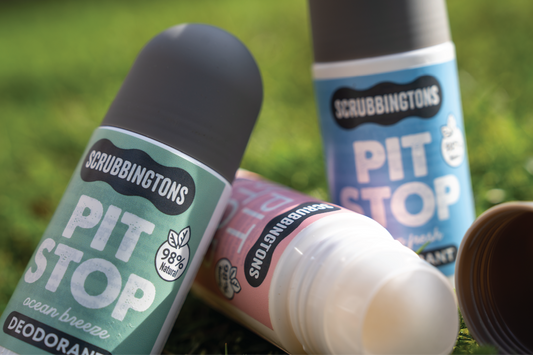
We made the kids' Pit Stop range for this stage, pretty much exactly. They're 75ml roll-ons. 98% natural, made without aluminium, alcohol or parabens, suitable for sensitive skin, and vegan and cruelty free if that matters in your house. Quick drying too. Sounds minor until it's 8.15 on a school morning.
Kids get three scents, Very Berry, Original and Coconut. All lightly fragranced, so if your child's skin is really reactive, do a small patch test first. It's a check, not a guarantee, but it'll tell you a fair bit. And let them choose. Honestly, that part does a lot of the work.
To be straight with you, Pit Stop is a deodorant. It controls odour and lets them sweat normally. Got a child whose shirt is wet through by break, or who still smells after a proper scrub? That's beyond what a deodorant does, ours or anybody's, and your GP is the person to ask.
Older kid wanting something a bit more grown up? The adult range comes in Ocean Breeze, Cotton Fresh and Floral Blossom. Still no aluminium, still no alcohol.
Frequently asked questions
What is the best deodorant for kids?
Is deodorant safe for kids?
Can kids use antiperspirant?
What age can kids start using deodorant?
Is natural deodorant good for kids?
What's the best kids' deodorant for sensitive skin?
Do kids need a different deodorant to adults?
Their first deodorant, sorted
Pit Stop kids' roll-ons are aluminium-free, alcohol-free and suitable for sensitive skin. Very Berry, Original or Coconut. Their call.
Shop kids' deodorant →